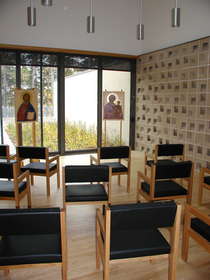
 This print hangs at the Sacred Heart Chapel at Saint Benedict’s Monastery, St. Joseph, MN (Originally published in the Catholic Times, July 12, 2012 © 2012 Mary van Balen)
Wednesday, July 11 was the feast of Saint Benedict of Nursia. Before his birth in 480, the Roman Empire was crumbling and various barbarian tribes had invaded Italy. Benedict studied in Rome during a peaceful interlude, but paganism and deteriorating conditions of the city were too much for the young man who left the city and lived as a hermit for a while in Subiaco. His holiness attracted others and eventually, he consented to become an abbot for a group of monks.
This first experiment did not end well; the monks tried to poison him! But later, Benedict did shepherd a number of small monastic communities, eventually founding the monastery of Monte Cassino. Benedict is most famous for his Rule that guided the lives of the monks. He called it a rule for beginners, but it has become the foundation for most monastic rules in the West.
I have had the opportunity to live near one of the largest Benedictine Abbeys in the country and spent time joining the monks in Liturgy of the Hours as well as Mass. Benedictine hospitality wraps around visitors and draws us in. After a few days, one becomes accustomed to the slow cadence of praying the Psalms, pausing at the end of each line regardless of punctuation, allowing God to slip into the hiatus.
I took time this morning to reread the Rule. Written so long ago, parts are no longer applicable, but for anyone desiring to grow closer to God, Benedict offers wisdom and guidance. In the Prologue, Benedict uses Scripture (He does so throughout as did Francis in his Rule.) to assure us of Gods desire for us, Gods loving Presence, and the Spirits voice speaking to all that have ears to hear. Famously, Benedicts Rule stresses moderation and flexibility. He aims to set down nothing harsh, nothing burdensome but a little strictness to amend faults and safeguard love.
He lays out structure for prayer, for meals, for hours of work and reading, but after he does so, is quick to say that they can be amended when illness, weakness, even the fluctuation of seasons require change.
He describes the good abbot as someone who teaches and inspires more by his actions than by his words. The abbot is expected to seek counsel from everyone when an important decision is to be made, for as Benedict notes, the Lord often reveals what is better to the younger. It is only in lesser issues that the abbot can consult the seniors only; a good lesson for todays church and its leaders. Those is power are called to listen not only to men who have rank in the hierarchy, but also to ordinary people, the faithful who receive and respond to the Spirit in everyday life.
The Rule stresses the value of silence and encourages the monks to refrain from casual speech or even too much laughter! These words do not mean that we should not enjoy conversation, a good joke, or lots of laughter, but that we would benefit from balancing that with times of silence. Times to listen with our hearts. Quiet time to remember that we rest in the presence of God. My place of work is never quiet. Music plays constantly even as televisions broadcast news or soap operas depending on the time of day and the preferences of those who are working. How many people wear ear buds hours a day? Silence often is avoided in our world. Benedicts words remind us of its importance.
If you are interested in learning more about Benedict, read the Rule. You might also try one of these books to help you discover what it has to offer us as we strive to deepen our relationship with the Holy One: Engaging Benedict by Laura Swan; Prayer and Community, by Columba Stewart OSB; Cherish Christ Above All, by Demetrius Dumm, OSB, and The Rule of Benedict: Insights for the Ages, by Joan Chittister.
 Rublev’s “Trinity” © 2012 Mary van Balen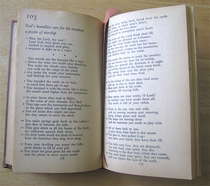
 PHOTO: Mary van Balen from Volume 4
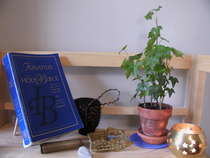
 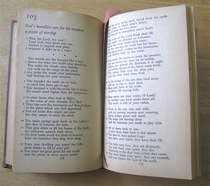 As I prayed the Psalter I thought of St. Athanasius (2295-373CE) whose feast was May 2. He is known for his fight against the heresy of Arianism that claimed Jesus was in no way equal to God the Father, having been created, but what I most remember about Athanasius is his wonderful letter to Marcellinus that spoke eloquently of the interpretation of the Psalms. While other books of the Bible are filled with words that inspire or instruct, yet remain the words of the author, words of the psalms are like one’s own words that one read; and anyone who hears them is moved at heart, as though they voiced for him his deepest thoughts.
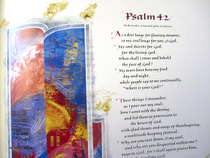 When I hold the old Psalter in my hands and pray the words printed there, I am connected not only with my monk friends, but also with my ancestors. I am in touch with my heart, and my journey and the God who embraces us all.
 PHOTO: Mary van Balen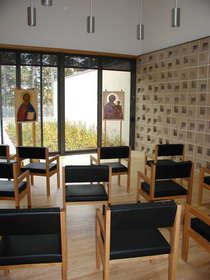
 PHOTO: Mary van Balen (Originally published in the Catholic Times, March 11, 2012 © 2012 Mary van Balen)
 Lent is a time that reminds us to consider our goal. Whatever discipline or practices we are using to observe this season are meant to help us focus on what is most important in our lives: our relationship with the Holy One. That is not something apart from the rest of our lives, but rather integral to everything we do. How we interact with people at our workplace, what we do to recreate body and spirit, how we respond to needs of others, how we live with our families and friends.
 The Wisdom we seek dwells within, a gift of the Incarnation. These weeks are good times to reflect on using Scripture and other writing that feeds our spirits. It is a time to reflect on how our relationship with God influences our interaction with the world.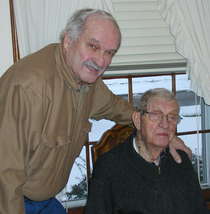
 PHOTO: Mary van Balen (First appeared in The Catholic Times, February 19, 2012 ©2012 Mary van Balen)
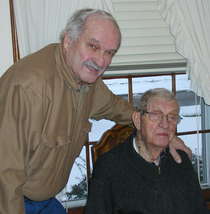 My brothers, sisters, and most of our cousins came to the funeral home to remember Adrian and share our stories. Afterward, we gathered at a local park shelter house to share food, laughter, and more stories. Death provided an opportunity for us to reconnect and to celebrate not only Adrians life, but also the lives of family and friends that were intertwined with his.
 Liturgically, we are approaching Lent, when we celebrate the Paschal Mystery of Christs birth, death, and resurrection. This is the ultimate understanding of death leading to new life. Jesus was born lived his life, and in the end, was murdered by humanity that could not accept the challenge of love and compassion he proclaimed.