Cassini’s trajectory into Saturn
Even though it was a day off, I woke at 6:45, pulled on my old black t-shirt with the solar system silkscreened half on the front, half on the back. It’s seen eclipses and meteor showers. It would bid farewell to the Cassini spacecraft on Friday morning, September 15.
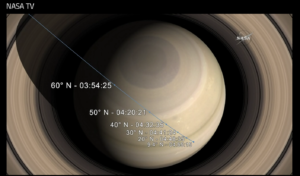
In the kitchen, I began preparing food for a daughter’s visit while watching NASA TV’s coverage of the final half-hour of the Cassini mission.
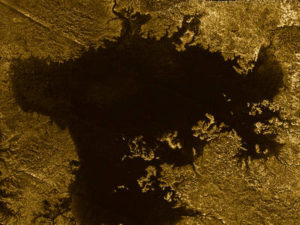
Ligeia Mare – Sea on Titan (False color)
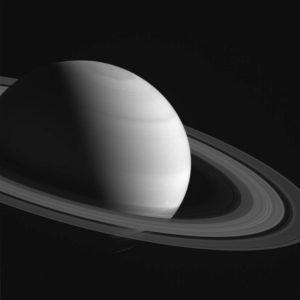
I listened to scientists sharing their thoughts as Cassini sped towards its fiery end in Saturn’s atmosphere. My iPad, sitting on top of the microwave, streamed live interviews with project scientists and engineers, some of whom had spent entire careers working on the Cassini mission. There were images of Saturn and its largest moon, Titan, with methane-rich lakes and rivers. Computer-generated graphics showed Cassini’s 22 dives into the dark space between Saturn and its rings as well as how the spacecraft would meet its end by entering the atmosphere and burning up.
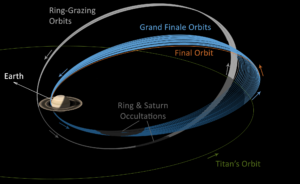
Cassini’s Grand Finale orbits
I was glad making chili didn’t require much attention because mine was on the screen. The images were mesmerizing. (NASA has made an eBook of some of those images and it’s available to download here.)
While chopping onions and green peppers, I learned more about the unexpected length and scientific bounty of this mission as well as the team’s ability to make changes in orbits and trajectories to take advantage of surprise discoveries almost 900 million miles away.
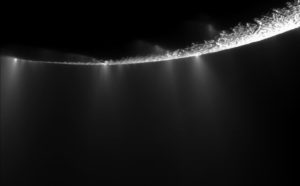
Narrow jets of gas and vapor from Saturn’s moon Enceladus
For example, when geysers of vapor were found spewing out of the south pole of Saturn’s tiny moon, Enceladus, the spacecraft actually flew through them and analyzed the composition, finding ice particles, water vapor and organic chemicals. Cassini also determined that beneath the moon’s icy surface sloshes an ocean of salty water.
For the last ten minutes of the broadcast, I turned my full attention to the screen. Even from my kitchen, I wanted to be one of the thousands, maybe millions around the world, waiting for that last signal from Cassini.
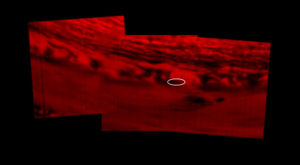
Where Cassini entered Saturn’s atmosphere
Through the commentary of those who had worked most closely with it from the beginning, the spacecraft had taken on an anthropomorphic quality, doing everything it had been asked to do, right down to the last images sent as it struggled against Saturn’s atmosphere.
The vastness and variety of creation overwhelmed me as the final signals faded. In my kitchen, chili was simmering. On Titan, methane rivers flowed. Saturn’s majestic rings, better understood, still grace our night skies.
Human imagination and wonder have paired with knowledge and skill to give us an extraordinary window into the universe. From ancient times, human beings have marveled at the night sky. Never before have we had such a view.
 My response is gratitude for those who have worked so long and hard to provide it. And to bend my knee before the One who creates it. I join with the ancient psalmist in prayer: The heavens proclaim the glory of God/and the firmament shows forth the work of his hands./Day unto day takes up the story/and night unto night makes know the message./ No speech, no word, no voice is heard/yet their span goes forth through all the earth,/their words to the utmost bounds of the world.
All images are from NASA
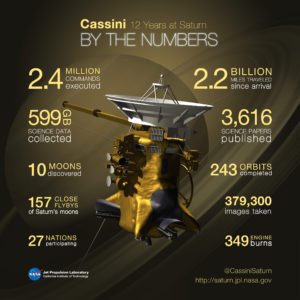
Cassini 12 Years at Saturn
The Cassini-Huygens mission was a joint effort of NASA, the European Space Agency, and the Italian Space Agency, Agenzia Spaziale Italiana. Many other countries were involved in the manufacturing of components.
What’s NASA doing next? Read this NYT article for some tantalizing descriptions of missions already on the calendar.
 Originally published in The Catholic Times, November 12, 2016 issue
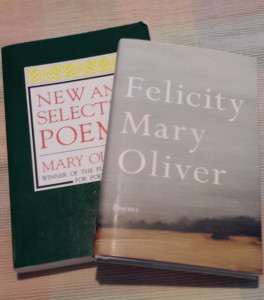 My day was off to a confused start. It was the time change. Usually, the clock by my bed adjusts for moving into or out of daylight savings time, but not this morning. Or maybe I just read it wrong. I hurried, washed my hair, and drove to church. No one was there. That’s when I realized: Daylight savings time was back. Sigh. Not a fan.
 Bright sun was a welcome change from the grey overcast days we’d been having. I hurried along the sidewalk, passing upscale condos along the street adjacent to the downtown parking lot where my car waits everyday while I’m at work. The brown sandstone cathedral sits just across the street. I thought about dropping in, but opted for the church of buildings and people, cars and cracked sidewalks instead. The cathedral would be locked anyway.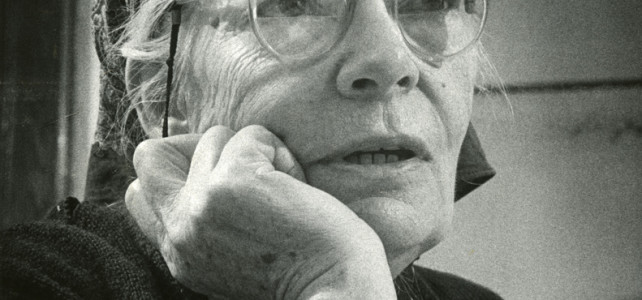
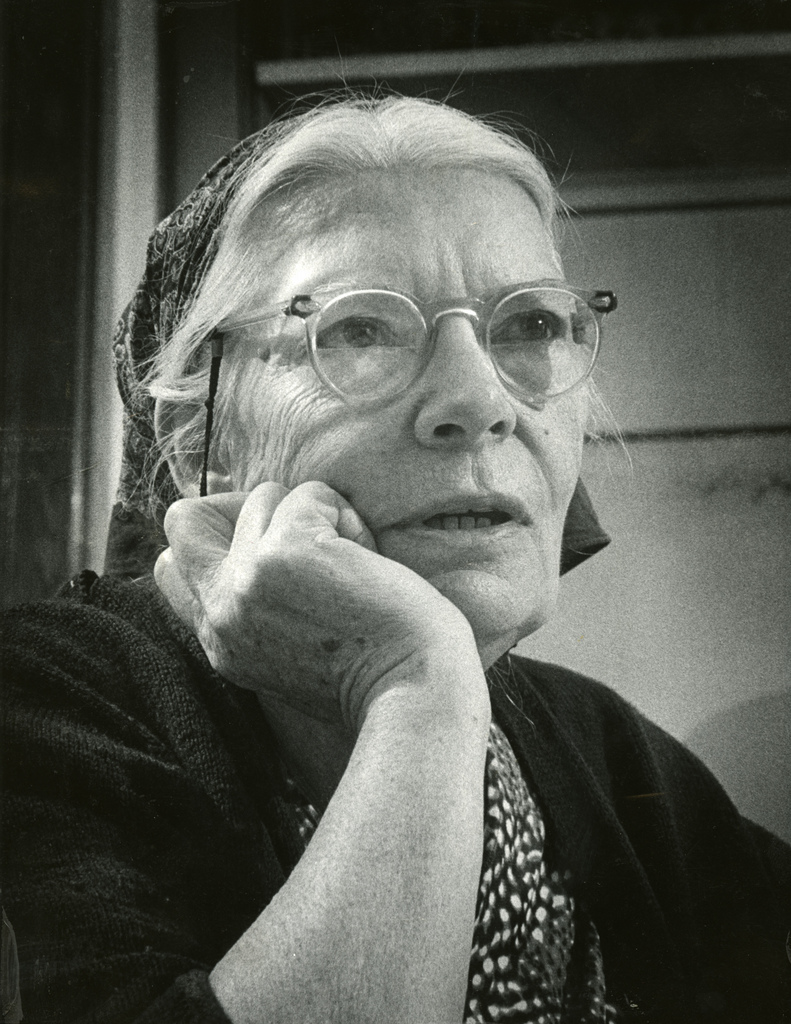
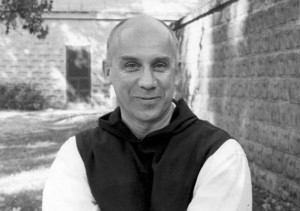 Pope Francis also recommended Merton’s openness to God in a contemplative style of prayer. Merton in the midst of a world immersed in “noise” of all types—digital, visual, aural—pouring out of players, electronics, out of the depths of our souls, calls us to quiet presence. For those who fill up every moment with activity and distraction, he says, “Be still. Listen.”